
 EN
EN
 ar
ar bg
bg hr
hr cs
cs da
da nl
nl fi
fi fr
fr de
de el
el hi
hi it
it ko
ko no
no pl
pl pt
pt ro
ro ru
ru es
es sv
sv tl
tl iw
iw id
id lv
lv lt
lt sr
sr sk
sk sl
sl uk
uk vi
vi et
et hu
hu th
th tr
tr fa
fa ms
ms hy
hy ka
ka ur
ur bn
bn mn
mn ta
ta kk
kk uz
uz ku
ku
Kingmach Vibrating Wire vs Potentiometric Displacement Sensors
Key takeaways
- Vibrating wire sensors are generally preferred for harsh outdoor and long-term monitoring when frequency output, low drift, and limited site access match the project requirements.
- Potentiometric sensors remain practical for protected, accessible, cost-sensitive applications that need simple position feedback or faster continuous response.
- The final choice must include the complete measurement chain: sensing principle, enclosure, mounting, cable, readout, power, sampling rate, calibration, and maintenance plan.
Harsh-environment displacement monitoring is not decided by one accuracy value. Rain, condensation, dust, temperature change, electrical noise, long cables, repeated movement, and limited maintenance access can alter the reliability and cost of the complete measurement chain.
This guide compares vibrating wire and potentiometric displacement sensors by operating principle, signal behavior, mechanical wear, environmental risk, response needs, and lifecycle cost. It also explains how Kingmach displacement transducers based on differential inductive, magnetostrictive, digital, wire-rope, and GNSS technologies fit when neither comparison technology is the best project match.
Quick answer for harsh environments
Vibrating wire sensors are generally preferred for harsh outdoor and long-term monitoring applications when the project needs stable frequency-based readings, long cable runs, and infrequent maintenance. This is a selection tendency, not a universal rule. The enclosure, sealing, installation, readout, and cable system still determine field performance.
Potentiometric sensors can be the better engineering choice in protected machinery, laboratory fixtures, temporary tests, or accessible equipment. They provide a straightforward analog position signal and can respond well to continuous motion. Buyers should qualify wiper life, contamination risk, cycle count, output conditioning, and maintenance access before using them in exposed infrastructure.
How the two sensing principles work
Vibrating wire displacement sensing
A vibrating wire displacement sensor transfers movement through a mechanical linkage that changes tension in a fixed wire. An electromagnetic coil excites the wire and detects its resonant frequency. The readout converts that frequency into displacement through the sensor calibration. Because the measured variable is frequency rather than a small change in resistance or voltage, normal cable-resistance variation has less influence on the engineering value. Cable continuity, shielding, moisture protection, and compatible excitation and readout electronics still matter.
This principle suits slow structural movement, crack opening, joint movement, convergence, and geotechnical deformation monitored over months or years. It is less suited to high-speed motion control when the required sampling rate exceeds the sensor and readout capability. During RFQ review, confirm range, mechanical transfer, frequency band, temperature measurement or compensation, cable length, readout compatibility, calibration equation, and expected sampling interval.
Potentiometric displacement sensing
A potentiometric displacement sensor moves a wiper along a resistive track. The wiper divides the applied excitation voltage, so the output voltage changes with position. The principle is direct, easy to integrate, and capable of fast response. It works well when the excitation is stable, the analog input is suitable, and the sensor remains within its electrical and mechanical travel.
The sliding contact introduces a wear mechanism that must be checked against movement frequency and service life. Dust, moisture, vibration, damaged seals, cable resistance, grounding, and analog noise can also affect the output. In a protected and maintainable installation, these risks may be manageable. In a remote tunnel, bridge, dam, or slope installation, replacement access and false trend data can outweigh a lower initial sensor price.
| Decision factor | Vibrating wire | Potentiometric | Engineering implication |
|---|---|---|---|
| Measured signal | Resonant frequency | Resistance ratio / analog voltage | Confirm the readout and cable architecture before purchase. |
| Long-term field use | Strong fit for slow structural monitoring | Depends on wiper, track, and sealing life | Use service duration and access cost in the comparison. |
| Mechanical contact | No sliding electrical contact in the sensing wire | Wiper slides on a resistive track | Review cycle life and contamination risk. |
| Cable and noise | Frequency reading is generally robust over field cables | Analog output needs careful conditioning and grounding | Verify maximum cable length in the complete system. |
| Response | Usually selected for slower structural change | Can suit faster continuous position feedback | Match sampling rate to the actual movement. |
| Maintenance | Often chosen where access is limited | Can be practical where inspection is easy | Include site visits and replacement work in lifecycle cost. |
| Typical fit | Bridges, tunnels, dams, slopes, foundations | Machinery, test rigs, protected temporary setups | Application fit matters more than a blanket technology ranking. |
Verified Kingmach product video
The Kingmach JMDL-52XXADT video provides a product-level reference for displacement meter form, installation planning, and system integration. The JMDL-52XXADT uses differential inductive frequency modulation; it should not be labeled as a vibrating wire or potentiometric sensor. Use the video to review the physical product, then confirm the exact sensing principle and readout architecture in the RFQ.
Watch the JMDL-52XXADT Differential Displacement Meter video
Engineering selection decision flow
- Classify the site. For clean, protected, and accessible equipment, evaluate potentiometric sensing. For wet, dusty, temperature-variable, or remote locations, continue with a rugged field technology screen.
- Set the monitoring duration and access plan. Multi-year monitoring with expensive site visits favors low-drift sensors and a measurement chain designed for unattended operation.
- Define movement speed and sampling rate. Slow structural change often suits vibrating wire. Faster continuous position feedback may favor potentiometric or another technology with the required bandwidth.
- Check signal distance and acquisition. Match the sensor output to cable length, logger input, excitation, grounding, shielding, power, data conversion, and alarm logic.
- Compare lifecycle risk. Include sealing, mechanical wear, calibration traceability, spare parts, replacement access, commissioning tests, and the cost of missing or misleading data.
What makes a displacement monitoring site harsh
A harsh site may combine water ingress, condensation, dust, corrosion, vibration, electrical disturbance, long cable distance, installation impact, restricted access, and seasonal temperature movement. The sensor housing and cable entry can be as important as the sensing element. Buyers should review IP rating, connector or cable sealing, mounting orientation, drainage, grounding, surge protection, and enclosure design together.
Bridge joints add traffic vibration and water. Tunnels add humidity, dust, construction damage, and limited access. Slopes and dams may need remote power, long-distance communication, and unattended monitoring through seasonal change. A foundation pit changes quickly and leaves little time for troubleshooting. Each site requires a different balance of sensing principle, physical protection, data acquisition, and maintenance access.
Where potentiometric sensors remain a strong fit
Potentiometric sensors are useful when the installation is protected, the travel is clearly defined, the movement rate suits the rated cycle life, and maintenance access is straightforward. Typical applications include machine position feedback, laboratory fixtures, test stands, factory automation, and temporary measurement setups. Their simple analog interface can reduce integration effort when the control system already accepts the required excitation and signal.
Do not reject a potentiometric option only because the project is industrial. Instead, verify the enclosure, seal, track technology, wiper life, linearity, allowable speed, side load, operating temperature, cable specification, and replacement procedure. A well-qualified potentiometric sensor in a controlled installation can be more appropriate than a slower or more complex field-monitoring technology.
When another displacement technology fits better
The vibrating wire versus potentiometric comparison does not cover every displacement problem. Large surface movement may require GNSS. Long travel or an indirect movement path may suit a wire-rope sensor. Absolute non-contact linear position may suit magnetostrictive sensing. A local crack or expansion joint may need a sealed digital crack gauge or differential displacement meter.
For relative structural movement, the Kingmach JMDL-52XXADT Differential Displacement Meter uses two coupled inductive coils and digital output to reduce environmental influence. Where non-contact absolute position is required, the JMCW-21XXADT Magnetostrictive Displacement Meter provides a separate technology path. Neither product should be described as a vibrating wire model.
For cracks and joints, the JMDL-22XXAT Smart Crack Gauge provides purpose-built mounting and range options. Keep detailed range, accuracy, IP rating, and communication comparisons in the companion Displacement Meter Specifications Guide. This article should remain focused on sensing principles and selection logic rather than repeat a complete product catalog.
Verified project context
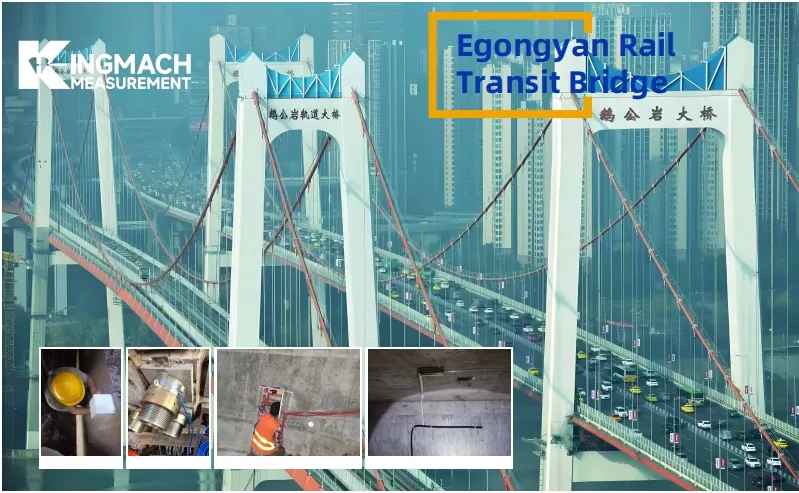
Egongyan Rail-only Bridge, Chongqing (2019)
The Egongyan Rail-only Bridge project combined cable-force, deflection, crack, and environmental monitoring. Its equipment list includes a smart crack gauge, strain gauges, load cells, inclinometers, accelerometers, weather sensors, and an automated monitoring system. The project illustrates a system-level selection rule: displacement data must work with the other structural measurements and the acquisition platform. For a bridge RFQ, define the movement point, range, mounting, exposure, cable route, sampling interval, alarm threshold, and inspection access before choosing the sensing principle.
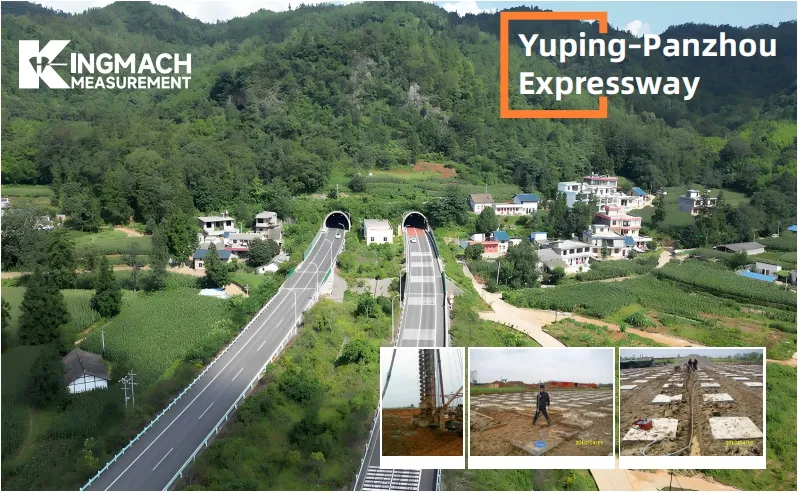
Yuping-Panzhou Expressway, Guizhou (2023)
The Yuping-Panzhou Expressway project covered tunnel settlement, arch-waist convergence, crack, and structural strain monitoring. Smart crack and laser displacement measurement were used with hydrostatic level and vibrating-wire strain instruments. This is a useful distinction: a project can use vibrating-wire instruments without every displacement sensor being vibrating wire. Buyers should label each sensing principle correctly, confirm the matching readout channel, and specify how crack opening, convergence, settlement, and strain will be interpreted together.
Procurement and lifecycle cost checks
Potentiometric sensors often have a lower unit cost, while vibrating wire and rugged digital systems may require specialized readouts or higher initial system investment. Compare the configured measurement chain rather than sensor price alone. A configuration-based quotation should include the sensor, cable, mounting hardware, readout or logger, enclosure, power, software mapping, calibration documents, commissioning, spares, and delivery terms.
- Request the expected mechanical and electrical service life under the planned movement cycle and environment.
- Confirm output type, excitation, sampling rate, cable length, logger channel, grounding, and surge protection.
- Specify IP rating, temperature limits, cable entry, mounting hardware, and access for zeroing or replacement.
- Ask for calibration coefficients, serial traceability, installation guidance, warranty, lead time, and spare-part availability.
- Include the cost of site visits, data gaps, false alarms, and replacement work in the commercial comparison.
Common selection mistakes
- Choosing by nominal accuracy without checking drift, repeatability, temperature response, mounting, and field signal quality.
- Calling every frequency-based or digital displacement product a vibrating wire sensor without verifying the actual sensing element.
- Using a potentiometric sensor in an exposed location without qualifying sealing, wiper life, analog conditioning, and replacement access.
- Ignoring required sampling rate. Structural trend monitoring and high-speed motion control need different sensor and readout architectures.
- Comparing sensor prices while excluding cable, logger, power, enclosure, commissioning, maintenance, and failure consequences.
Match the sensing principle to the project
Send Kingmach the movement type, range, expected speed, installation location, environmental exposure, cable distance, sampling interval, acquisition platform, maintenance access, and quantity. The engineering team can compare the available displacement technologies and identify the documentation needed for a reliable RFQ.
Contact Kingmach for a displacement sensor reviewFrequently asked questions
Are vibrating wire displacement sensors always better than potentiometric sensors?
No. Vibrating wire sensors are generally preferred for slow, long-term monitoring in harsh or remote environments. Potentiometric sensors can be better for protected, accessible applications that need simple analog position feedback or faster continuous response.
What is the main weakness of a potentiometric displacement sensor?
The sliding wiper and resistive track create a mechanical contact that can wear or become noisy. The risk depends on cycle count, speed, side load, sealing, contamination, vibration, and maintenance access.
Why is a vibrating wire frequency signal useful over long cables?
The readout derives displacement from resonant frequency, so normal cable-resistance variation has less effect than it can have on a low-level resistance or voltage measurement. Cable continuity, shielding, moisture protection, and compatible readout electronics still matter.
Is the Kingmach JMDL-52XXADT a vibrating wire sensor?
No. The JMDL-52XXADT uses a differential inductive frequency-modulation principle with two coupled coils and digital output. It should be evaluated as a separate rugged displacement technology.
What information belongs in a harsh-environment displacement sensor RFQ?
Include movement type, range, speed, sampling interval, accuracy requirement, temperature, water and dust exposure, mounting, cable distance, output, power, readout or logger, calibration, maintenance access, quantity, and delivery requirements.
Final note: Select the sensor only after the sensing principle, mechanical transfer, environmental protection, signal chain, sampling rate, and maintenance plan have been checked against the project drawings and monitoring thresholds.